
How an Apartment Community is Developed in Florida
Developing new housing is a complex, costly, and often lengthy process. Interact with different development timelines to see how developers in Florida navigate potential pitfalls as they work to create new apartment communities across the state.
Select Your Development
Select a prototype to explore how development-related risks impact costs, timelines, and affordability of apartment communities in Florida.
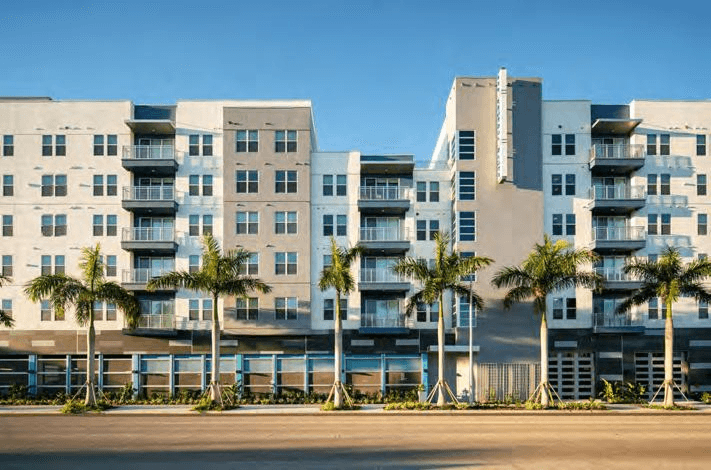
Podium Building
Greater Tampa Metro Area
Mid-rise urban development with ground-floor parking and four to six residential floors. Typical for urban infill sites in high-growth markets across Florida.
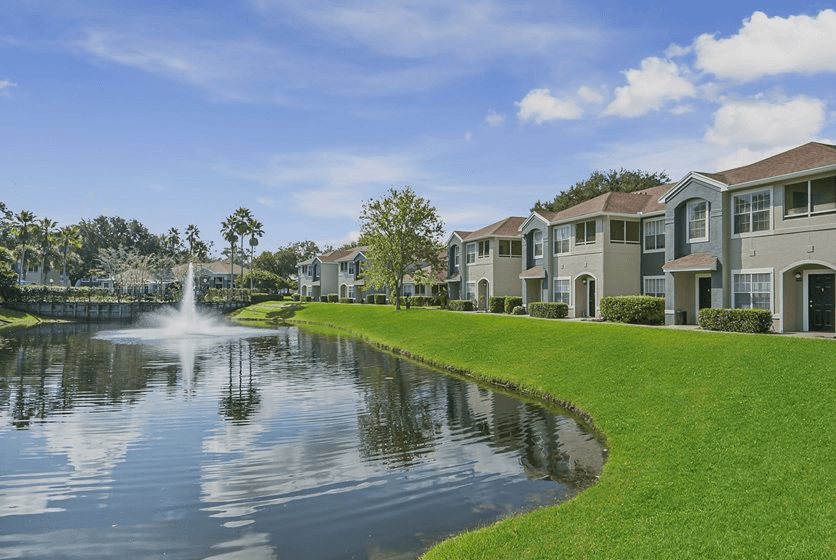
Garden Apartment
Greater Jacksonville Metro Area
Low-rise suburban development with surface parking. Common in secondary markets with lower land costs and development intensity.
Why is the required rent affected?
Rules, fees, and delays shape local housing markets as much as supply and demand. Every time a new housing project moves through the process, the rules determine how much time, risk, and money it takes before anyone moves in.
Carrying Costs Become Rent
Most projects are financed with loans. Developers borrow to buy land, hire designers, and prepare for construction. If zoning reviews, hearings, or legal challenges stretch on for months or years, the interest on those loans keeps accumulating. Each extra month adds cost without adding a single new home. Those “carrying costs” eventually end up in the final rent or sale price. A delay that adds $5 million in financing costs across 200 units can mean hundreds of dollars more per month for each future tenant.
These financing costs can also rise unexpectedly when interest rates increase. Because most construction loans have variable rates, even modest rate hikes can significantly raise monthly payments during a project’s delay. When approvals take longer, developers are exposed to more rate fluctuations — meaning the longer the wait, the higher the risk that borrowing costs will climb and ultimately push up rents even further.
Can't it come from the developer's profit?
At first glance, it seems like developers could simply absorb higher fees or slower approvals. In reality, the financing behind housing is fluid and competitive. The money that funds new apartments — from banks, pension funds, private equity, or real-estate trusts — can be invested elsewhere.
When local rules make housing slower or more expensive to build, investors shift their capital to places where returns are clearer and timelines are shorter. A fund deciding between two metro areas will choose the one where it can build sooner, lease faster, and face less uncertainty.
When that happens, construction in the more regulated market drops. Fewer projects mean fewer new homes, and with demand still high, rents rise for everyone who stays.
Glossary of Terms
Key development terminology referenced throughout this guide.
- DRC (Development Review Committee)
- A cross-department staff committee (planning, engineering, utilities, fire, etc.) that reviews development applications together to confirm they meet technical codes, providing consolidated feedback that must be resolved before a project advances.
- Concurrency
- Florida’s requirement that supporting infrastructure—roads, schools, parks, water, sewer, and other services—has available capacity (or committed upgrades) before development approvals are granted, often enforced through capacity reservation reviews.
- PUD (Planned Unit Development)
- A negotiated master plan and custom zoning district that lets a developer mix uses or modify standard zoning rules in exchange for meeting conditions set during a rezoning-style approval process.
- Comprehensive Plan
- The local government’s long-range blueprint for land use, housing, transportation, and conservation; every parcel has a future land use designation, so projects that don’t align must secure a comprehensive plan amendment through a legislative hearing process.
- Entitlements
- The bundle of legal development approvals—rezonings, variances, special exceptions, PUDs, and similar actions—that establish what can be built on a site before detailed permitting begins.
- NIMBY
- An acronym for “Not In My Backyard,” describing community opposition that can add cost, time, or political risk to development proposals during public hearings or review processes.
- Impact Fees
- One-time charges imposed on new development to fund infrastructure expansions (roads, parks, schools, utilities) required to serve added demand, typically collected at building permit stage.
- Certificate of Occupancy
- The final approval from the building department confirming completed construction is safe for use, allowing the developer to open, lease, or occupy the building.
- By-right Development
- A project that meets existing zoning and land use standards and therefore receives administrative approval without discretionary hearings, providing a faster, more predictable path to permits.
- Administrative Approval
- A decision made by professional staff, rather than elected officials, when a proposal meets objective code criteria—an approach that speeds reviews by avoiding public hearings.
Case Studies
States across the country are grappling with how to deal with these issues.
In 2019, Texas tackled slow local approval processes by enacting House Bill 3167, known as the “shot clock” law. This reform imposed a strict 30-day deadline on cities and counties to review and decide on subdivision plans and development plats. Under the law, if a city does not approve or formally reject a subdivision application within 30 calendar days of submission, the application is deemed approved by default. Furthermore, if the city asks for revisions (a conditional denial), it must then make a final decision within 15 days of the resubmission – preventing iterative delays.
Implementation
Cities like Austin had to urgently modify their processes to comply. Many introduced new internal timelines, pre-submittal requirements, and more frequent meeting schedules to ensure every application gets timely consideration. Notably, some small subdivision requests that previously needed planning commission approval were delegated to administrative approval to save time.
Outcomes
This reform has significantly reduced the time and uncertainty for developers in plat approvals. Instead of projects stalling for months in review cycles, decisions now come in weeks. Developers gained leverage – the threat of automatic approval by lapse of time forced local departments to streamline. A side effect is that staff now front-load the process (insisting on complete applications and rigorous pre-checks) to avoid clock complications. Overall, HB 3167 accelerated the early-stage approval of subdivisions, which is often Step 2 in development (part of local entitlement).
Lessons
A hard statutory deadline can be a powerful tool to combat bureaucratic delays. However, it also required local governments to invest in process improvements (like better tracking systems and perhaps more staff) to meet the mandate. Other states considering similar “shot clocks” should note Texas’s experience: clear legal timelines plus default approval if the timeline is missed create strong accountability. This reform particularly benefits developers in jurisdictions that used to drag out preliminary approvals – it cuts down the endless rounds of comments and gives developers a predictable schedule for breaking ground.
Methodology
The Florida Development Timeline calculator is an interactive proforma analysis tool that demonstrates how regulatory risks, delays, and costs impact apartment development projects in Florida. It uses a target return on cost (ROC) approach with fixed land costs to calculate how various development challenges translate into increased rents, construction costs, and project timelines.
This is not a traditional residual land value (RLV) analysis. While RLV methodology is used once to establish a baseline land cost, the land price is then frozen for all scenarios. The calculator solves for required rent needed to achieve target returns when costs increase, which models a developer who has already committed to a land purchase at a fixed price.
This reflects a common real-world situation: a developer has already acquired land (or is under contract) at a fixed price, then discovers additional costs during entitlements. Since the land price cannot be renegotiated, the developer must determine what rent levels are needed to achieve their target return on the now-higher total project cost.
Step 1: Calculate Base Case
Establish the "no risk" scenario that serves as the reference point. This step uses RLV methodology to calculate an initial land cost assumption. HR&A interviewed local developers and used cost data from local and national sources (FAA, CoStar, RSMeans, Rentology, Yardi) to construct the base-case proforma.
Step 2: Apply Risks
We then modify the base case according to the user-selected factors that reflect the identified risks. Based on previous FAA research, risks are decomposed into soft costs, hard costs, and timeline delays. The policy that results in reduced units also affects the net-income of the property and triggers a hard-cost penalty to account for the economies of scale lost due to the regulatory hurdle.
Step 3: Recalculate Financing Costs
After aggregating the risk parameters, we then recompute financing costs based on the new timeline and construction cost. Delays increase financing costs as construction loans accrue interest over time.
Step 4: Solve for New Rent
Finally, we calculate the new rent required to achieve the original target return given increased costs.